
The Dispatch
Weekly Insights into Society & Politics (February 2026- Edition 23)

International
Who is Tariq Rahman?
BNP is on the Verge of Victory in Bangladesh
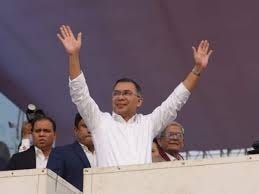
The Bangladesh Nationalist Party (BNP) is now on the verge of securing a decisive mandate in Bangladesh’s national elections, with party leader Tarique Rahman emerging as the frontrunner for the prime minister’s office.
Although the final certification of results is awaited, the party’s claim suggests a significant political shift in Dhaka’s leadership landscape.
Prime Minister Narendra Modi congratulated Bangladesh Nationalist Party (BNP) leader Tarique Rahman after his party won an overwhelming majority in the general elections, asserting that India will continue to back a democratic Bangladesh.
In a post on social media, PM Modi conveyed his “warm congratulations” to Rahman for leading the BNP to victory.
In the social media post, PM Modi also said, “This victory shows the trust of the people of Bangladesh in your leadership. India will continue to stand in support of a democratic, progressive and inclusive Bangladesh. I look forward to working with you to strengthen our multifaceted relations and advance our common development goals.”
The coming weeks will be critical in assessing how the new political configuration shapes Dhaka’s domestic priorities and its approach toward regional partnerships.
Who is Tarique Rahman?
At 60, Tarique Rahman represents the latest chapter in the influential Zia political legacy. Son of former prime minister Khaleda Zia and former president Ziaur Rahman, founder of the Bangladesh Nationalist Party (BNP), Rahman has long been central to the party’s leadership trajectory.
His rise, however, has been marked by controversy. During the tenure of former prime minister Sheikh Hasina, he faced multiple corruption charges and was convicted in absentia, including a life sentence in 2018 over the 2004 grenade attack case—allegations he maintains were politically driven.
Following Hasina’s ouster in August 2024, Rahman returned to Bangladesh in December to a strong public reception. As BNP chairman since January 2026, he steered the party’s electoral strategy and secured victories from Dhaka-17 and Bogura-6. With the BNP’s sweeping win, he now stands on the threshold of becoming Bangladesh’s next prime minister, showcasing both a dynastic return and a decisive political shift.
–
Stepping Towards Comprehensive Strategic Partnership
India- Malaysia Ties Deepens with Cooperation in Various Sectors
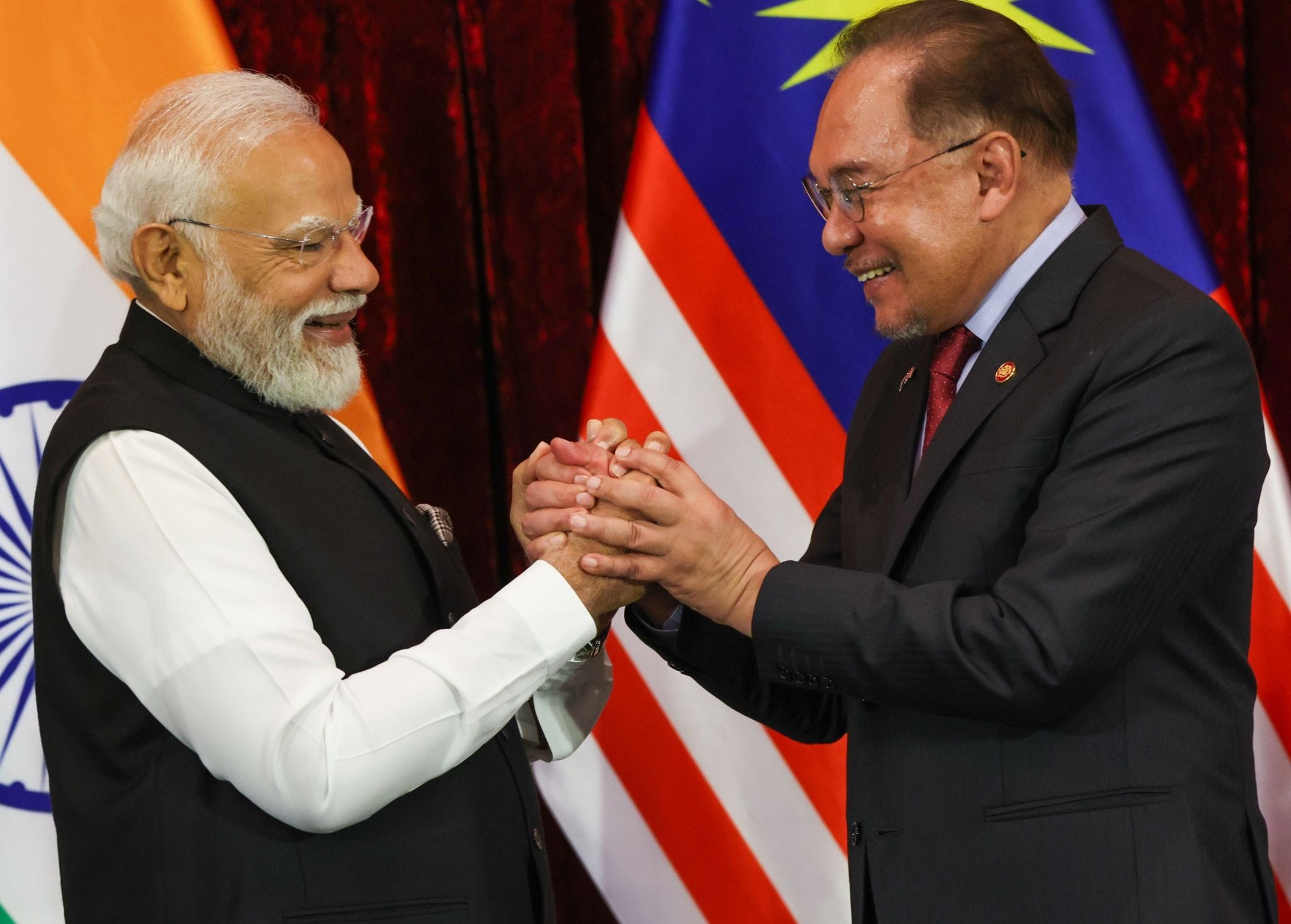
Prime Minister Narendra Modi’s two-day official visit to Malaysia marks his first trip since the bilateral relationship was elevated to a Comprehensive Strategic Partnership in 2024.
The visit to Kuala Lumpur signals a consolidation phase in India–Malaysia ties rather than a symbolic engagement.
Strategically, the visit underscores India’s calibrated outreach to Southeast Asia amid shifting Indo-Pacific dynamics. Defense and security cooperation are expected to receive renewed emphasis, reflecting shared concerns over maritime stability and regional balance.
In a special gesture underscoring the warmth of bilateral ties, Malaysian Prime Minister Anwar Ibrahim personally received Prime Minister Narendra Modi upon his arrival in Kuala Lumpur. He was joined by Malaysia’s Minister of Human Resources, Dato’ Sri Ramanan Ramakrishnan, and Deputy Foreign Minister Dato’ Lukanisman bin Awang Sauni.
The ceremonial reception was followed by a vibrant cultural welcome that highlighted the deep civilizational and cultural linkages shared by India and Malaysia—symbolically reinforcing people-to-people ties alongside strategic cooperation.
The visit aims to consolidate the India–Malaysia Comprehensive Strategic Partnership established in 2024. It reflects India’s sustained commitment to elevating bilateral engagement as a key pillar of its Act East Policy, Indo-Pacific vision, and the broader Vision MAHASAGAR framework, positioning Malaysia as an important partner in India’s extended neighborhood diplomacy.
The visit thus represents a shift from broad diplomatic intent to structured implementation—anchoring India–Malaysia relations within a more strategic, outcome-oriented framework.
India- Malaysia: from Cultural Exchange to Deeper Strategic Trade Ties
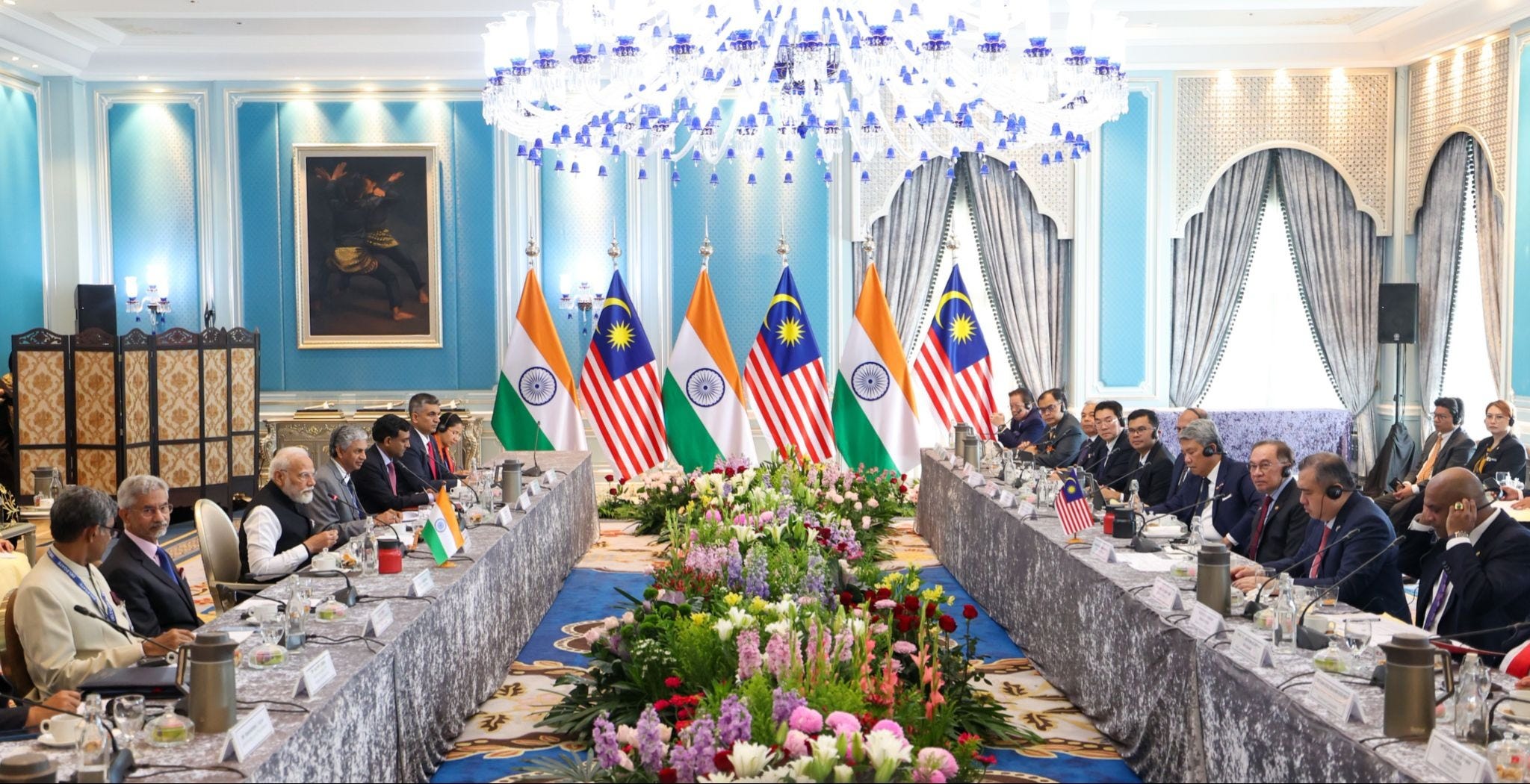
Recognizing India as a key global economic partner, Malaysia welcomed the steady growth in bilateral trade, with both sides describing the partnership as one grounded in mutual value and strategic complementarity. The two leaders agreed to advance trade facilitation measures and unlock new avenues of cooperation in high-growth sectors such as semiconductors, the digital economy, and industrial collaboration—signaling a shift toward technology-driven economic engagement.
They reaffirmed the centrality of the Malaysia-India Comprehensive Economic Cooperation Agreement (MICECA) and the ASEAN-India Trade in Goods Agreement (AITIGA) in anchoring economic ties. Both leaders welcomed the ongoing review of AITIGA to ensure it remains mutually beneficial, trade-facilitative, and aligned with evolving global trade practices.
At the same time, they underscored the untapped potential of MICECA in deepening economic integration and called for its optimal utilization to strengthen supply chains, market access, and long-term commercial linkages between the two economies.
Following the talks, several important bilateral agreements, including on digital payments, security cooperation, semiconductors, health and medicine, disaster management, combating corruption, audio-visual co-production, technical and vocational education, UN peacekeeping cooperation and social security for Indian workers were exchanged. Malaysia also completed all procedures for its accession to the International Big Cat Alliance (IBCA).
Prime Minister Narendra Modi conveyed his heartfelt thanks to Prime Minister Anwar Ibrahim and the people of Malaysia for the gracious reception and generous hospitality accorded to him and his delegation.
Reaffirming the importance of sustained high-level engagement, he extended an invitation to Prime Minister Anwar Ibrahim to undertake a visit to India at a mutually convenient time, underscoring the shared resolve to further deepen bilateral cooperation.
–
Claim, Counterclaim, Consequence
White House Comes with Factsheet on India-US Trade Deal
Donald Trump has built much of his political persona around bold, repetitive, and often controversial claims—turning assertion into a central instrument of strategy. Whether on election integrity, economic performance, immigration, or foreign policy, Trump’s communication style relies on confident repetition, framing narratives in ways that energize supporters while provoking critics.
Making the same claims, US President Donald Trump on 11th February reiterated his claim that he played a decisive role in halting the India–Pakistan tensions that followed Operation Sindoor in May 2025.
Trump asserted that he used the threat of tariffs as leverage to de-escalate the situation, describing trade measures as a strategic tool to pressure both sides toward restraint. The remarks add to his earlier assertions regarding Washington’s involvement in defusing the post-Operation Sindoor standoff, even as official accounts from New Delhi have consistently maintained that issues with Pakistan are addressed bilaterally.
Factsheet from White House
The United States has revised its trade deal fact sheet with India, notably removing “pulses” from the list of agricultural products eligible for tariff reductions. The update signals a recalibration in the scope of market access under the evolving bilateral trade framework.
White House said, The United States of America (United States) and India are pleased to announce that they have reached a framework for an Interim Agreement regarding reciprocal and mutually beneficial trade (Interim Agreement). Today’s framework reaffirms the countries’ commitment to the broader U.S.-India Bilateral Trade Agreement (BTA) negotiations, launched by President Donald J. Trump and Prime Minister Narendra Modi on February 13, 2025, which will include additional market access commitments and support more resilient supply chains.
According to the White House, India has indicated its intention to purchase over $500 billion worth of U.S. energy, technology, and other goods under the revised arrangement.
The statement also said, The proposed scale of procurement underscores the expanding economic dimension of India–U.S. ties, even as sector-specific sensitivities—particularly in agriculture—continue to shape negotiations.
On this factsheet, India’s Ministry of External Affairs also showed its agreement. As per MEA’s official statement, “The joint statement is the framework and remains the basis of our mutual understanding in the matter. Both sides will now work towards implementing this framework and finalising the interim agreement.”
It’s also stated, “The amendments in the US fact sheet reflect the shared understandings contained in the joint statement.”
So, India did not comment on Trump’s tall claims about the India-Pakistan war, but silently achieved its best from the US to create its own place in the global market. India never indulged in Trump’s claims but stood on its strong footing.
–
National
Correction of Historical Mistake
MHA Mandates All 6 Stanzas of Vande Mataram
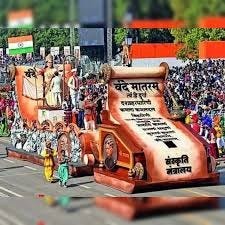
In a significant directive, the Union Home Ministry has mandated the rendition of the complete six-stanza version of Vande Mataram—lasting 3 minutes and 10 seconds—at a wide range of official functions. The order covers occasions such as the unfurling of the national flag, the arrival of the President at ceremonial events, and before and after presidential addresses, as well as similar protocols for Governors.
The January 28 order also clarifies that when both Vande Mataram and the national anthem, Jana Gana Mana, are performed, Vande Mataram will precede the anthem. Attendees are required to stand at attention during its rendition.
The move represents a shift from the stance adopted by the Indian National Congress leadership beginning in 1937, when concerns were raised by sections of the Muslim community regarding certain verses seen as invoking Hindu deities. The directive is expected to rekindle discussion over historical sensitivities and the evolving interpretation of national symbols in public life.
The ministry has also made it clear that members of the audience must stand in attention pose when the national song is played. However, this will not be mandatory inside cinema halls when ‘Vande Mataram’ is played as part of a film or news reel, as a standing audience interferes with viewing of the film and can lead to disturbance of peace and disorder”.
The Ministry clarified that when both the National Song and the National Anthem are played at the same event, Vande Mataram must be rendered first, followed by the National Anthem. The new protocol aims to ensure uniformity and proper decorum in the observance of the National Song at official events across the country.
–
Institutional Activities
Symposium on
Ideological Metamorphosis of Left: From Class to Culture
The Shastri Institute, Pune, organized a focused symposium examining the ongoing ideological transformation within the Marxist tradition. Committed to objective and rigorous social science research, the Institute continues to foster critical engagement with evolving intellectual currents shaping academia and public discourse.
The symposium explored the shift from class-based frameworks to identity- and culture-centric narratives within the broader Left, and assessed its implications for contemporary society and politics.
The discussions focused on the shift from class-based analysis to increasingly identity- and culture-centric frameworks, and the wider implications of this transition for society and politics. Prof. Kedar Naik opened the symposium with an exploration of the evolution of socialism, followed by Dr. Akshay Ranade’s lecture on Transmogrification of the Left: An Indian Experience. The concluding session, led by Dr. Kaushik Gangopadhyay, examined the politics of the New Left.
The deliberations collectively initiated a structured discussion on the changing ideological foundations of the Left and their broader academic and political consequences.
- Curated by Sharayu Bapat
Research Assistant, SSRISS
Follow us: